Begin with when you use electricity
A home with most demand in the evening, a business operating through the day and a building with overnight equipment need different assessments. Start with your bill and the pattern behind it. When available, interval consumption data gives a clearer picture than a single annual total.
Tell Jelvis about plans for an EV, heat pump or business expansion. Future demand belongs in the discussion, but we should identify which changes are confirmed and which are only possibilities. Oversizing for a future project that never happens can leave equipment underused.
Capacity and output are different
Battery capacity, measured in kWh, describes stored energy. Output power, measured in kW, describes how quickly the system can supply that energy. A large battery with a lower power limit may still rely on the grid when several appliances run together.
Ask for the usable capacity, not just the nominal figure. For a simple illustration, a 10 kWh usable battery supplying a constant 2 kW load would last roughly five hours before allowing for losses and reserve settings. Actual operation depends on the equipment, temperature, charging state and varying loads. This is not a runtime guarantee.
Solar storage or tariff-led charging?
A compatible system can store surplus solar PV electricity for later. Some systems also allow scheduled charging from the grid. Assess this against the import tariff, export income you might give up, charging losses and equipment cost.
A battery does not automatically offer the strongest financial outcome. Compare a solar-only proposal with a storage option using the same demand and tariff assumptions. Tariffs may change, and a good export arrangement can affect the value of storing energy instead.
Already have solar PV?
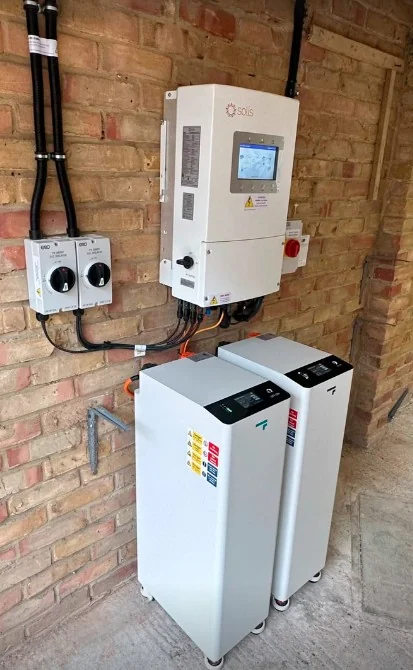
Send the existing inverter model, panel details, installation date and any handover documents you have. Depending on the system, storage may be added through compatible hybrid equipment or a separate AC-coupled arrangement. We need to confirm the combination rather than assume two products work together because their capacities look suitable.
Your installation location also matters. Equipment needs a suitable position, working space, access and an installation that follows the applicable manufacturer and safety requirements. Product dimensions alone do not describe the total space needed.
Specify backup separately
If power-cut support matters, identify the loads: lights, refrigeration, communications or particular equipment. Backup requires a compatible design and electrical arrangement. Available power, starting loads and stored energy matter; the rating of a gateway does not tell you how much backup power the inverter can deliver.
What to share with Jelvis
- Your postcode and recent electricity bill.
- Existing solar PV and battery model details, if available.
- Typical daytime and evening usage.
- Your import and export tariff, if known.
- EV or heating plans and any backup priorities.
Our product guide includes Fox ESS, Anker SOLIX, Fogstar and other system examples. Choose “recommend a system for me” in the enquiry form if you would prefer us to explain the options. You do not need to pick a brand before speaking to us.
Further reading: Energy Saving Trust: energy storage explained.